Provider review
A licensed provider reads your health intake, including kidney function and medicines, decides if metformin is right for you and chooses the dose.
Prescription medicine, by prescription
Metformin extended-release tablets after a licensed provider's review. Approved for type 2 diabetes; other uses are off-label. Filled by a US-licensed pharmacy and shipped free.
From $107/mo with the 12-month plan and auto-refill
How would you like to pay?
Choose your plan
Prescription treatment requires an online medical evaluation. A provider decides whether treatment is appropriate; approval is not guaranteed.
Your plan
A licensed provider reads your health intake, including kidney function and medicines, decides if metformin is right for you and chooses the dose.
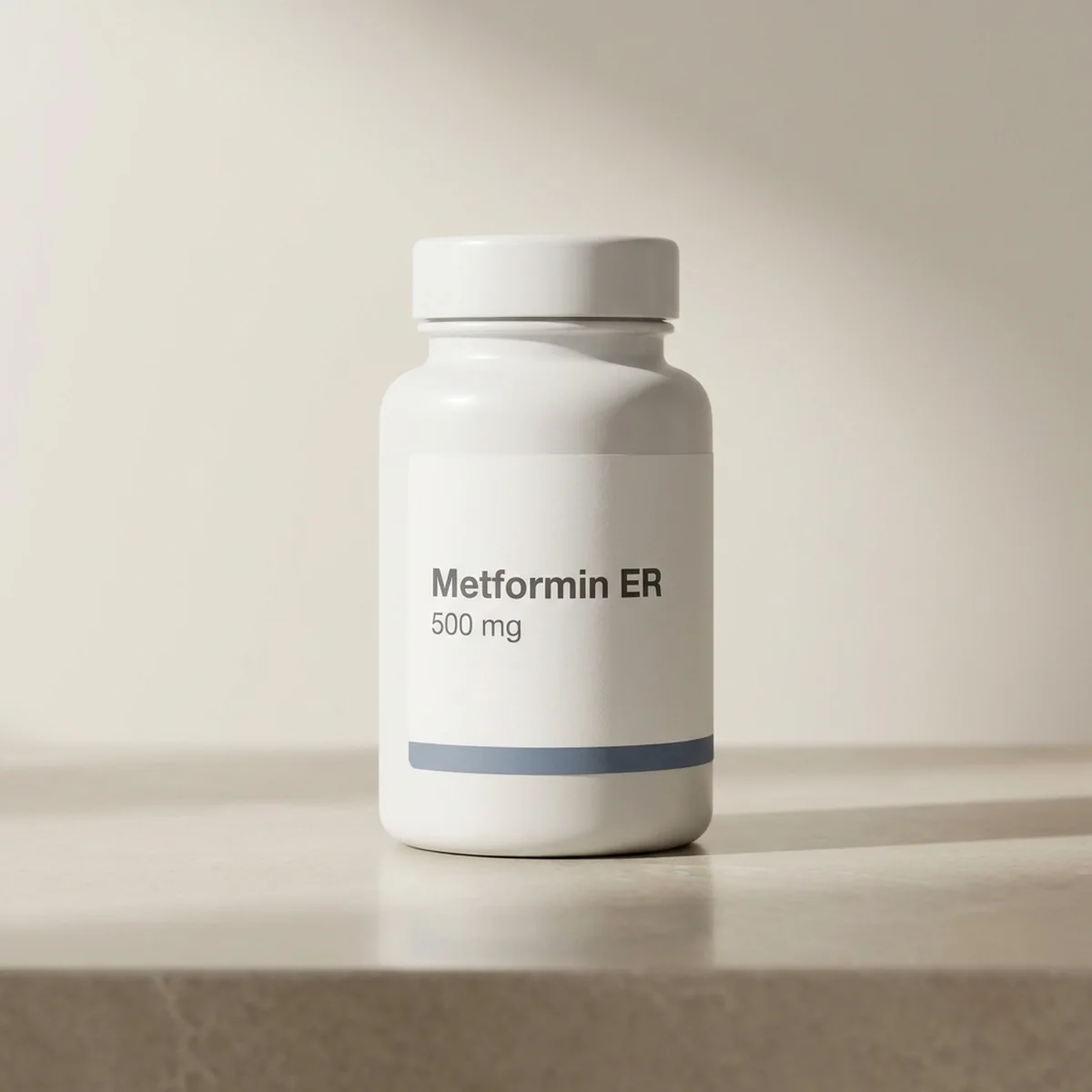
Metformin ER 500 mg tablets, dispensed by a US-licensed pharmacy after approval.
Delivered to your door at no added cost.
Pay once, or turn on auto-refill and take 10% off. Change or cancel refills anytime.
A printable decision pack and a plain checklist for reading a study.
Help with your order and delivery when you need it.
How it works
Pick 1, 3, 6 or 12 months. Auto-refill takes 10% off each plan.
Answer a private online questionnaire. A licensed provider reviews it and chooses the dose.
If prescribed, the pharmacy fills your order and ships it to you free.
FAQ
The things people ask most before starting Metformin ER.
Metformin extended-release 500 mg tablets, after a licensed provider's review. Your provider chooses the dose. A US-licensed pharmacy dispenses your order and ships it free.
Metformin ER paid once: $149 for 1 month, $402 for 3 months, $760 for 6 months or $1,430 for 12 months. With auto-refill each is 10% off: $134, $361, $684 and $1,287 ($107.25 a month on the 12-month plan). Shipping is free, and the exact total is shown before you pay.
Yes. You complete an online health intake, including your kidney function and the medicines you take, and a licensed provider decides whether metformin is right for you and chooses the dose. Choosing a plan does not guarantee a prescription.
Yes, for type 2 diabetes. The label for metformin hydrochloride extended-release tablets states the tablets are indicated as an adjunct to diet and exercise to improve glycemic control in adults with type 2 diabetes mellitus, and Drugs@FDA lists an original approval for Glucophage XR (metformin hydrochloride) extended-release tablets dated 10/13/2000. Use for other purposes is off-label: an FDA patient page says that once FDA approves a drug, healthcare providers generally may prescribe it for an unapproved use when they judge that it is medically appropriate for their patient, and that FDA has not determined that an approved drug is safe and effective for an unapproved use.
The label says metformin decreases hepatic glucose production, decreases intestinal absorption of glucose, and improves insulin sensitivity by increasing peripheral glucose uptake and utilization. A review abstract says metformin-induced activation of the energy-sensor AMPK is well documented but may not account for all actions of the drug, and another says widely studied mechanisms such as complex I inhibition leading to AMPK activation have only been observed at supra-pharmacological (>1 mM) metformin concentrations that do not occur in the clinical setting.
The sources are mixed. In the randomized Diabetes Prevention Program, lifestyle intervention reduced diabetes incidence by 58 percent and metformin by 31 percent compared with placebo, and lifestyle was significantly more effective than metformin; at 15 years the cumulative incidences of diabetes were 55% with lifestyle, 56% with metformin and 62% with placebo. A meta-analysis of randomized trials associated metformin with a modest weight reduction in obese nondiabetic patients, while another meta-analysis found no evidence for effects on weight in drug-naive patients with type 2 diabetes. On aging, a retrospective observational cohort and a meta-analysis reported longer survival or lower all-cause mortality in people with diabetes taking metformin than in non-diabetic comparison groups, a review concluded the evidence shows an emerging uncertainty about its anti-aging potential, and randomized trials in older adults reported that metformin negatively impacted the hypertrophic response to resistance training and attenuated the increase in insulin sensitivity and VO2 max after aerobic training. The MA.32 randomized trial in breast cancer did not find a significant improvement in invasive disease-free survival.
The label states that the most common adverse reactions (> 5.0%) are diarrhea, nausea/vomiting, flatulence, asthenia, indigestion, abdominal discomfort, and headache. In its table of adults with type 2 diabetes, diarrhea was 10% versus 3% and nausea/vomiting 7% versus 2% for the tablets (n=781) versus placebo (n=195), and diarrhea led to discontinuation of the tablets in 0.6% of patients. The label's patient information says common side effects include diarrhea, nausea, and upset stomach, that these side effects generally go away after you take the medicine for a while, and to tell your doctor if they bother you a lot, last for more than a few weeks, come back after they’ve gone away, or start later in therapy.
The boxed warning in the label states that postmarketing cases of metformin-associated lactic acidosis have resulted in death, hypothermia, hypotension, and resistant bradyarrhythmias, and that its onset is often subtle, accompanied only by nonspecific symptoms such as malaise, myalgias, respiratory distress, somnolence, and abdominal pain. It lists renal impairment, concomitant use of certain drugs (e.g., carbonic anhydrase inhibitors such as topiramate), and age 65 years old or greater among the risk factors. A 2010 Cochrane review of 347 comparative trials and cohort studies reported no cases of fatal or nonfatal lactic acidosis in 70,490 patient-years of metformin use, while an observational cohort study found metformin use associated with an increased risk of acidosis at eGFR less than 30 mL/min/1.73 m2 (adjusted HR, 2.07; 95% CI, 1.33-3.22).
The label states the tablets are contraindicated in patients with an eGFR less than 30, that initiation is not recommended in patients with eGFR between 30 to 45, and that an eGFR should be obtained at least annually. It says to stop the tablets at the time of, or prior to, an iodinated contrast imaging procedure in patients with an eGFR between 30 and 60, and that patients should be warned against excessive alcohol intake because alcohol potentiates the effect of metformin on lactate metabolism. The label also says to re-evaluate eGFR 48 hours after the imaging procedure and restart the tablets if renal function is stable, and its patient counseling section says to instruct patients to inform their doctor that they are taking the tablets prior to any surgical or radiological procedure, as temporary discontinuation may be required.
One generic label's highlights state that metformin may lower vitamin B12 levels and say to monitor hematologic parameters annually and vitamin B12 at 2 to 3 year intervals. A secondary analysis of the randomized Diabetes Prevention Program and its Outcomes Study (metformin 850 mg twice daily) concluded that long-term use of metformin was associated with biochemical B12 deficiency and anemia and that routine testing of vitamin B12 levels in metformin-treated patients should be considered.
The label states that limited data with the tablets in pregnant women are not sufficient to determine a drug-associated risk for major birth defects or miscarriage, and that published studies have not reported a clear association with metformin and major birth defect or miscarriage risk but cannot definitely establish the absence of any metformin-associated risk. On breastfeeding it says there is insufficient information to determine the effects of metformin on the breastfed infant. The label's patient information says it is not known if the tablets will harm an unborn baby and that a patient who is pregnant should talk with their healthcare provider about how to control blood sugar, and says it is not known if metformin hydrochloride passes into breast milk.
In 2020 the FDA recommended recalls of certain metformin products that may contain the impurity N-nitrosodimethylamine (NDMA) above the acceptable intake limit, and said FDA testing has not shown NDMA in immediate release metformin products. Its update page says patients taking recalled ER metformin should continue taking it until a doctor or pharmacist gives them a replacement or a different treatment option.
No. You can pay once for 1, 3, 6 or 12 months, or turn on auto-refill and take 10% off. You can change or cancel refills anytime.